

For years over 600 million IP addresses appeared to sit at a farm near Potwin, Kansas. None of them was there, but police and strangers kept turning up. MaxMind's geolocation database needed somewhere to put every address it could only place as “somewhere in the United States”. It chose the middle of the country, which was somebody's front yard. The owners sued, and the case was settled in September 2017.
The default moved to the middle of a Kansas lake.

The lake is still in use. According to MaxMind’s free GeoLite2 City data of November 13, 2026, 969 million IPv4 addresses sit at 37.751, -97.822, and none of them has a city.
How close is close enough?
Vendors typically quote country-level accuracy at 95% to 99%, so “IP geolocation is 99% accurate” might be right for country and therefore currencies or geo fencing. MaxMind estimates 99.8% at the country level, and IP2Location claims over 99.5%. In November 2026 MaxMind's own comparison tool reported 61% of US addresses placed within 50 km of their true position. The UK was 68%, Sweden 46%, and China 64%. That leaves nearly 4 in 10 US addresses either placed more than 50 km out or with no city given at all. A result counted as correct can still be up to 50 km out.
51Degrees is different. For each IP address we return an area, and the device associated with the address is in that area 95% of the time. How small the area is depends on where in the world the address is, so we measure it by region. The table shows the quarter of High confidence broadband IPv4 addresses with the smallest areas.
| Region | Typical area | From the point to the nearest and furthest edge |
|---|---|---|
| United States | 6,700 km² | 25 to 63 km |
| Europe (EEA and UK) | 9,600 km² | 21 to 93 km |
| Rest of the world | 5,300 km² | 21 to 58 km |
Each typical area is under 10,000 km², which is equivalent to city level.

We compare 51Degrees with MaxMind and IPinfo regularly and publish the results on our IP Intelligence comparison page, which also compares our features with Digital Element’s. Each line in the chart compares a pair of vendors. We measure the distance between their answers for the same IP address, then average those distances across the addresses sampled. Distance between answers doesn't establish which answer is correct, so disagreement alone isn't evidence that 51Degrees got the location right.
Where the connection comes out
Cellular traffic leaves the network through gateways that can sit a long way from the phone. Manchester, in the north west of England, looks like London! On November 6, 2026, our data held about 45 million cellular IPv4 addresses, and half of them pointed to an area of about 350,000 km² or more, which is roughly the size of Germany. On a connection like that the latitude and longitude will be wrong, and you should ignore them.
Staff working around the world can have much the same problem when their traffic leaves the company network through a single office. With a VPN or proxy, the location belongs to the server passing on the user's traffic. That server may be somewhere else. An unsure vendor can also fall back to the network owner's registered address, often in a capital city, which is why there's a skew with MaxMind to London, Paris, and Berlin among others.
What an area tells you
At DMEXCO, the digital marketing trade show in Cologne, in September 2026, every ad tech company that named its IP geolocation vendor to us named one that returns a point and a radius, a circle.
I'm baffled that an industry that talks continuously about trust and integrity persists in holding on to an outdated view of the world.James RosewellCEO, 51Degrees
We return an area with an irregular boundary. These polygons can leave out places that a circle would include.

The device associated with the IP address is in the area 95% or more of the time, and the point we also give you is the most likely place within that area. If you need a city, the large East Coast area on the map is no use to you, even with our point inside it. At least with 51Degrees you'll know.
LocationConfidence reports High, Medium, or Low. High means you can rely on the location given, which might still be a large area. A UK cellular address comes back High for “somewhere in the UK” and claims nothing more. Discard Low for decisions where getting the location wrong matters. For Medium, we'd preselect a currency on the website and let the visitor change it.
Our Geographic Areas post goes into the difference between a polygon and a circle.
When you need more precision
IP geolocation is the only signal that is instant, server-side, and friction-free, because an IP address on its own doesn't identify a person. So for location, start with the IP address and use it to get to GPS. Before you've asked for anything you already have a country, a currency, a language, and a rough area. For a store finder or delivery, we'd ask for a more precise location even if we'd already returned High for the IP address. GPS and the browser's location service are accurate to a few meters. The visitor has to agree to a permission pop-up, and you won't have those coordinates on the first request to your server. Once you have them, our geolocation service, built on OpenStreetMap, turns the coordinates into places.
Getting the visitor to agree comes down to psychology. People accept a permission pop-up when they can see what they get back, so we'd wait until a precise location is plainly worth something to them, and say why we're asking. A pizza site that already says “we deliver in your area” can ask where to bring the order. The visitor is being offered a value exchange, their location for a pizza at the right door, and by then they've seen enough to give GPS permissions.
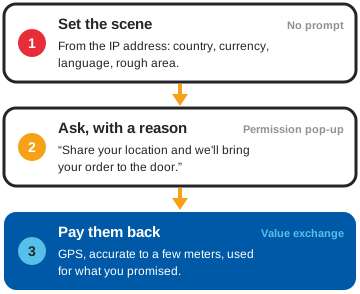
You can ask the user where they are. The answer can go stale when they move, or be a fib when the honest answer costs more, as with prices that differ by country. You might decide to leave the choice to visitors and give everyone the same country dropdown, currency, and promotions.
If you pass a location to companies buying and selling ads, fill in the fields that say where it came from. In OpenRTB, the standard for ad requests, a location type of 2 marks the latitude and longitude as worked out from an IP address, and the IP location service field names the vendor. For 51Degrees, that field also carries the confidence, with 511 for High and 512 for Medium.
Try an address you know
Our free IP address tester shows the location and network information we call IP intelligence, including the area, the confidence, the network type, and VPN and proxy flags. No sign-up needed.